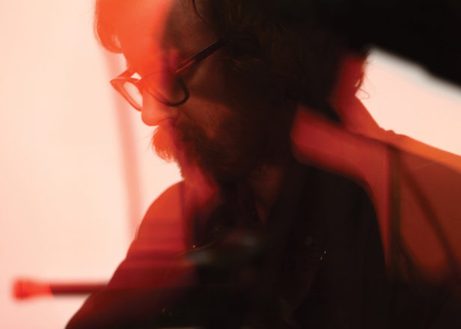
Photo by Martin Escalante
John Wiese
Lampo Performance Series
Nov 18, 2017
(8pm)
RSVP Required
John Wiese returns to Lampo to perform his new four-channel composition Time Column—a work that the Los Angeles-based artist says “imposes vertical time on horizontal sounds.”
John Wiese (b.1977, Ft. Leavenworth, KS) works primarily in recorded and performed sound with a focus on installation and multi-channel diffusions, as well as scoring for large ensembles. He is a prolific artist with various ongoing projects, including the concrète grindcore band Sissy Spacek, and collaborations with Evan Parker, C. Spencer Yeh, Aaron Dilloway, Kevin Drumm, Lasse Marhaug and others. In 2011 he released his 100th 7-inch record, celebrated with a retrospective exhibit and monograph. Many of these recordings were published on his Helicopter label, and on more than 50 independent labels from around the world. Wiese has toured extensively and has appeared at several leading international festivals.
In May 2012 John Wiese performed three new works for Lampo—a quad diffusion of Magical Crystal Blah, a new version of Battery Instruments, and a concrète improvisation.
Since 2010 the Graham Foundation has supported and partnered with Lampo to produce this performance series held at the Madlener House. Lampo, founded in 1997, is a non-profit organization for experimental music and intermedia projects.

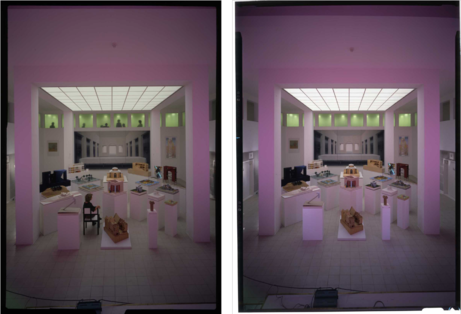
Atelier Markgraph, photograph for cover of Nouveau Plaisirs d’architectures catalog (1984)
Oliver Elser
Chicago Architecture Biennial Partner Program
Nov 17, 2017
(5pm)
Talk
Please RSVP
Oliver Elser, historian and curator, will present his lecture Models of Postmodernism–Postmodernisms Models. Elser will examine the founding of the Deutsches Architekturmuseum in Frankfurt in 1984. His lecture focuses on German architectural collector and founder Heinrich Klotz, and architect Oswald Mathias Ungers and their collaboration to produce a model museum in a historic villa.
Oliver Elser is a curator at the Deutsches Architekturmuseum (DAM) in Frankfurt, Germany. His practice includes criticism, teaching, and archival based exhibition making. After studying architecture at the Technical University of Berlin, Elser worked in Vienna as an architecture critic and journalist, publishing often in Der Standard, Architectural Digest, and profil. He has taught scenography at the University of Applied Sciences in Mainz and has shown work at the 2013 Venice Biennale in the exhibition Il Palazzo Enciclopedico. Exhibitions that he has curated include: The Architecture Model: Tools, Fetish, Small Utopia, DAM (2012); The 387 Houses of Peter Fritz, Venice Art Biennale (2013); Mission: Postmodern. Heinrich Klotz and the Wunderkammer, DAM (2014); Making Heimat. Germany, Arrival Country, German Pavilion at the Venice Architecture Biennale (2016); and SOS BRUTALISM – Save the Concrete Monsters!, DAM (2017).
This program is presented in partnership with the 2017 Chicago Architecture Biennial.
Shop Talk with the Chicago Art Book Fair
Graham Foundation Bookshop
Nov 17, 2017
(12:30pm)
Talk
Chicago Architecture Biennial Rooms for Books
Chicago Cultural Center
77 E Randolph Street, Chicago, IL 60601
Join us for a day-long series of programs presented by the Graham Foundation Bookshop and the Chicago Art Book Fair in the Rooms for Books at the Chicago Architecture Biennial. Throughout the afternoon, three exhibitors in the Book Fair will share current work and reflect on the conceptual process and physical project of making and designing books.
PROGRAM OF EVENTS
Bricks from the Kiln #3 Listening Preview
12:30 p.m.
Andrew Lister and Matthew Stuart give a multimedia preview of the third issue of Bricks from the Kiln with a four-part audio installation in each of the Rooms for Books quadrants.
The Managerial Arts of Books and Prosthetics with Soberscove Press
3:30 p.m.
On the occasion of Soberscove Press’ release of its new title, The Hysterical Material, designer David Khan-Giordano and editor Geof Oppenheimer discuss their approach to the art of catalog production with publisher Julia Klein.
The London Centre for Book Arts Show-and-Tell
5:00 p.m.
Ira Yonemura and Simon Goode describe the work of the London Centre for Book Arts and situate their practice within contemporary publishing in the UK.
PARTICIPANTS
Bricks from the Kiln, edited and designed by Andrew Lister and Matthew Stuart between Chicago and London, borrows its title from the glossary notes of Ret Marut's Der Ziegelbrenner, which was the 'size, shape and colour of a brick,' and ran for 13 issues between 1917 and 1921. Each issue of Bricks from the Kiln is ‘tentative, incomplete and inconsistent’ and ‘in flux and liable to crack.’
Soberscove Press seeks to make available art-related materials that fill a gap in the literature or are difficult to access (e.g. out-of-print, not in translation, previously unpublished, or limited in circulation). Their books tend to explore modes and functions of documentation and connect historical themes and issues to the present.
David Khan-Giordano lives and works in Chicago.
Geof Oppenheimer is an Associate Professor of Practice in the Arts at the University of Chicago. His practice takes up questions of civic value, the ways in which political and social structures are encoded in images and objects and how meaning is formed in the modern world.
The London Centre for Book Arts (LCBA) is an artist-run, open-access studio providing education programmes for the community and access to resources for artists, designers and makers.
PARTNERS
The Chicago Art Book Fair is dedicated to showcasing emerging directions and diverse legacies within small press arts publishing. The fair features an international group of over 100 arts publishers, small presses, book artists, comics artists, zinemakers and printmakers. The fair takes place from November 16–19 in the Chicago Athletic Association, and will also feature satellite programming and after parties. CABF is free and open to the public.
Rooms for Books is an installation conceived by MG&Co. for the 2017 Chicago Architecture Biennial. It transforms the traditional bookshop into a platform for reflection and for the presentation, documentation, production, and dissemination of the architecture book.
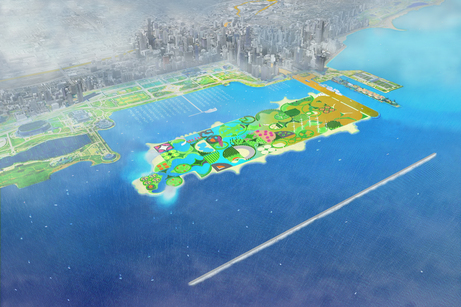
Filter Island, positioned between the Chicago River and Lake Michigan, Chicago
Bowling
UrbanLab
Nov 09, 2017
(6pm)
Book Launch
Please RSVP
UrbanLab will present their new Graham funded book, Bowling: Water, Architecture, Urbanism, which investigates the symbiotic relationships between architectures of quality and infrastructures of quantity in Chicago, New York, and the Sun Belt. The book is a conjecture of what a comprehensible city could be to combat (real and predicted) natural crises—through design-based analysis and experimentation.
UrbanLab is an architecture and urban design office cofounded by Sarah Dunn and Martin Felsen. The practice blends design and research to produce uniquely progressive, site-specific projects, resulting in a new aesthetic for environmentally resilient architecture, landscapes, and public space. The office’s realized projects range in scale from small houses to urban districts.
Sarah Dunn received her BA from Columbia College and her MArch from the Graduate School of Architecture, Planning and Preservation at Columbia University. Dunn is a partner in the architecture and urban design firm UrbanLab in Chicago. UrbanLab won the AIA College of Fellows Latrobe Prize (2009), was selected as an Emerging Voice by the Architectural League of New York (2010), and exhibited at the Venice Biennale (2012) and the Chicago Architecture Biennial (2015). Dunn is also an associate professor at the University of Illinois at Chicago.
Martin Felsen received his BArch from Virginia Tech and his MS from the Graduate School of Architecture, Planning and Preservation at Columbia University. Felsen is a licensed architect and a partner in the architecture and urban design firm UrbanLab in Chicago. Felsen is an associate professor at the Illinois Institute of Technology, College of Architecture. Felsen serves on the Board of Places Journal Foundation, the Board of Archeworks, and the Editorial Advisory Board of The Architect's Newspaper.
Related Graham Foundation supported project:
2014 Publication Grant to Sarah Dunn & Martin Felsen Bowling: Water, Architecture, Urbanism
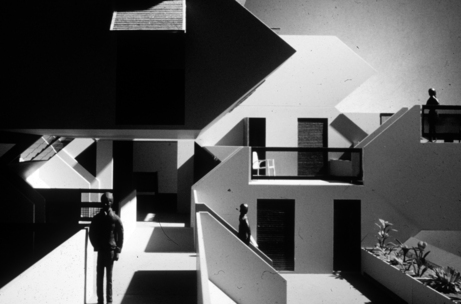
Habitat Puerto Rico, model showing terraces and view from walkway system, 1968. Courtesy Safdie Architects
Humanizing Megascale
Moshe Safdie
Oct 30, 2017
(6pm)
Talk
Please RSVP
Capacity is limited; the event will also be live streamed here.
Please note that seating for this event is on a first-come, first-served basis. Registration is required but does not guarantee entry. Doors open 30 minutes prior to the lecture for those registered in advance. Reservations expire 5 minutes before the start time, at which point seating will be released to the waitlist. Overflow viewing areas will be available on the first and second floors of the building.
The Graham Foundation is pleased to present a talk by Moshe Safdie in celebration of the 50th anniversary of the architect’s design for Habitat ’67 in Montreal. Completed early in his career, this project initiated a series of Habitat housing developments in New York, Israel, San Juan, and Singapore, among other cities that strove to foster new forms of community—bringing together nature, culture, and privacy within the city. Safdie discusses the unique challenges of the Habitat projects, as well as how these ideas have continued to inform and shape his contemporary practice.
This talk coordinates with the Graham’s presentation of David Hartt’s exhibition in the forest, a meditative installation and film, which investigates Safdie’s unfinished Habitat Puerto Rico as it stands today.
Moshe Safdie is an architect, urban planner, educator, theorist, and author. Over a celebrated 50-year career, Safdie has explored the essential principles of socially responsible design with a distinct visual language. A citizen of Israel, Canada, and the United States, Moshe Safdie graduated from McGill University. After apprenticing with architect Louis Kahn in Philadelphia, Safdie returned to Montréal, established his own firm in 1964, and realized Habitat ’67—a key component of the master plan for the 1967 World Exhibition. The innovative residential complex Habitat ’67, an adaptation of Safdie's undergraduate thesis, marked a turning point in modern architecture. Author of four books and a frequent essayist and lecturer, Safdie’s global practice includes work in North and South America, the Middle East, and throughout Asia and Australia. Projects span a wide range of typologies, including airports, museums, performing arts, libraries, housing, mixed use, and entire cities. His honors include the Companion of the Order of Canada; the Gold Medal from both the Royal Architectural Institute of Canada and the American Institute of Architects; la Medaille du Merite from the Order of Architects of Quebec, Canada; and Israel’s Rechter Prize. The Cooper Hewitt, Smithsonian Design Museum awarded Mr. Safdie the National Design Award for Lifetime Achievement in 2016.
The first floor of the Madlener House is accessible via an outdoor lift. Talks are held in the ballroom on the third floor, which is only accessible by stairs. Please call 312.787.4071 to make arrangements.
|
At present, the people of Puerto Rico continue to face a humanitarian crisis following the devastation left in the wake of hurricane Maria. People are still without access to food, clean water, power, and other daily necessities, and they face the daunting work ahead to rebuild their communities. If you would like to help, please consider donating to relief efforts at the link below:
Hurricane Maria Community Relief & Recovery Fund
|
To learn about additional ways to help, Americans for the Arts has organized a list of trusted organizations on their website, which can be accessed here.
For more information on the exhibition, in the forest, click here.


 PREVIOUS POSTS